Search engine optimisation has never stood still, but the pace of change in recent years has been particularly significant. Between AI-generated content flooding the web, Google’s continued evolution of its ranking systems, and shifting user behaviour, the SEO landscape of 2026 looks meaningfully different from what it did even two or three years ago.
For business owners and marketers, separating what genuinely moves the needle from what is now outdated – or actively harmful – is essential. Here is an honest assessment of the current state of SEO.
What Still Works
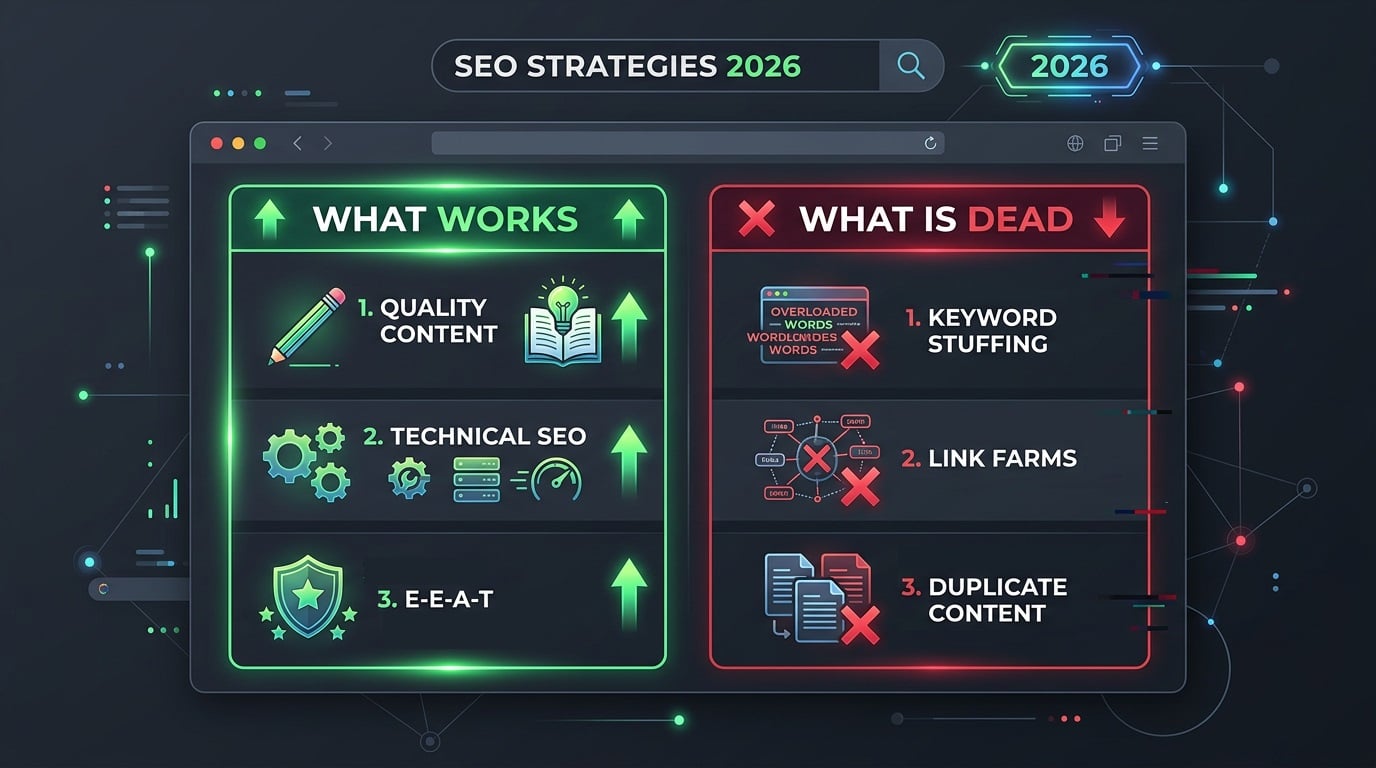
- High-quality, genuinely useful content: Content that answers real questions thoroughly, demonstrates expertise, and is written for humans rather than search engines remains the single most reliable SEO strategy. Google’s E-E-A-T framework (Experience, Expertise, Authoritativeness, Trustworthiness) continues to reward depth and credibility.
- Technical SEO fundamentals: Page speed, mobile optimisation, clean site architecture, structured data, and secure HTTPS are non-negotiable. These are the foundations upon which everything else is built.
- Earning authoritative backlinks: Links from credible, relevant websites remain one of the strongest ranking signals. The emphasis is on earning them through genuine value – not buying or manufacturing them.
- Search intent alignment: Understanding why someone is searching – not just what they are searching for – and matching your content precisely to that intent continues to be a decisive ranking factor.
- Local SEO: For businesses with a physical presence or geographic focus, an optimised Google Business Profile, consistent NAP (Name, Address, Phone) data, and local citations remain highly effective.
What Is Dead (or Dying)
- Keyword stuffing: Repeating keywords unnaturally throughout a page not only fails to help – it actively triggers quality penalties. Search engines now understand context and synonyms far more sophisticatedly.
- Thin, duplicated, or AI-spun content at scale: Publishing large volumes of low-effort content in hopes of capturing long-tail traffic is a strategy Google has become increasingly effective at identifying and demoting.
- Manipulative link schemes: Paid links, link farms, and private blog networks carry significant risk. Google’s spam detection has grown considerably more refined.
- Exact-match domain obsession: The assumption that owning a keyword-heavy domain gives a significant ranking advantage is outdated.
- Ignoring user experience signals: Dwell time, click-through rate, and engagement metrics increasingly influence rankings. A technically optimised page that users bounce from immediately sends negative signals.
What to Focus on in 2026
The overarching principle that unifies effective SEO today is genuine helpfulness. Build a website that loads quickly, works flawlessly on mobile, and contains content that your target audience actually wants to read and share. Earn your authority through quality rather than shortcuts.
Additionally, with AI-generated content now saturating many niches, the differentiator is original insight: case studies, proprietary data, expert opinion, and first-hand experience. These are things that cannot be mass-produced, and they are exactly what search engines are increasingly trained to reward.
SEO in 2026 is not more complicated than it has ever been – it has simply become less tolerant of shortcuts and more aligned with good business practice. Invest in quality, and the rankings will follow.